Konrad Peters
The Zone of InterestKonrad Peters, a former professor of modern history who became an intelligence official in the Nazi state, serves as Angelus Thomsen’s guide to two kinds of obscured truth: the fate of Dieter Kruger and the political choices behind mass murder. His manner is fastidious and formidable, but his explanations resist the comfort of treating extermination as either an abstract policy or a technical process. He traces decisions through institutions and changing pressures, then insists that the machinery could not have operated without human will. His later death in Dachau makes the inquiry personal as well as historical.
Identity and Background
Peters had taught modern history at Humboldt before joining the Security Service, where he helped monitor opponents of National Socialism and specialized, with sardonic precision, in Freemasons. He was an old friend of Thomsen’s father, a connection that gives Thomsen a route into official channels when the fate of Kruger becomes difficult to establish. The change from professor to intelligence officer places Peters inside the state he later scrutinizes: he knows the language and operations of its institutions, yet his conversations with Thomsen are marked by an awareness of what those institutions have made possible.
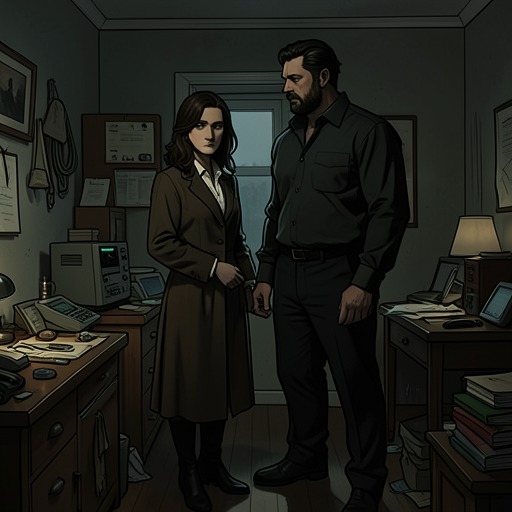
The novel gives him a sharply physical presence when Thomsen meets him in the Tiergarten on March 29. Older and more imposing than Thomsen remembers, Peters is short and vast, with a bow tie, a richly colored waistcoat, thick spectacles, and an almost completely bald head marked by deep frowns. The description makes him seem like a dandified giant cut off at the legs. His appearance carries a trace of theatricality, but his subject is not spectacle: he uses the walk to examine the political decisions and moral habits behind mass killing.
The Search for Dieter Kruger
Thomsen puts aside his ambivalence and contacts Peters first by teletype and then by telephone, asking about Kruger’s early imprisonment. Peters assures him that the telephone line is secure and responds as someone willing to use his position to help an old family connection. Thomsen supplies the dates he has been trying to reconcile: Kruger was arrested in Munich on March 1 and sent to Dachau on March 23. Peters recognizes him as part of the first group imprisoned there under Wackerle and remarks on the severity of that early period.
The initial inquiry produces no clear resolution. Ten days pass before Peters calls again from Berlin. He explains that the case is taking longer than expected because it is surrounded by an unusual opacity and settled silence. When Thomsen asks whether Kruger might have been drafted as prisons began to be emptied, the exchange leaves the question suspended rather than answered. The silence becomes part of the mystery: Kruger’s incarceration seems to vanish from the record, while the people searching for him encounter institutional resistance or absence.
The eventual confirmation comes not through Peters’s call but through a letter bearing the Chancellery’s gilt crest, which Paul Doll opens while seeking Kruger’s status and whereabouts. It states that Kruger was shot while fleeing in Leipzig on January 12, 1934. The delayed disclosure clarifies what had been hidden behind the blank stretch of his prison history. Peters’s role is therefore not to deliver the final fact, but to make visible how difficult it is to retrieve a life once the state has enclosed it in silence.
Explaining the Escalation of Mass Murder
In the Tiergarten, Peters situates the policy of extermination within a sequence of authorization, expectation, and pressure. He identifies July 31, 1941, as a decisive moment: a letter drafted by Eichmann and Heydrich and signed by Göring conveyed Adolf Hitler’s wish for a total solution and gave authority to begin. Peters does not present this as a complete blueprint for every subsequent step. He suggests that officials may initially have imagined deporting Jews to a remote, barren region beyond the Urals or in the Arctic after a rapid victory over Russia. As that territorial prospect receded, pressure mounted among competing authorities in Poland, where the annexation of three million more Jews intensified the perceived administrative problem. By August or September, Peters argues, the shift had reached a moral threshold: the killing extended from men, who had already been murdered for months, to women and children.
His account therefore holds central authorization together with radicalization among subordinate officials. A high-level order provides authority, but local competition and the failure of earlier plans help explain how policy changed in practice. Peters’s explanation does not reduce extermination to administrative improvisation: the adjustments are possible because the will to kill is already present. The novel uses his account to show how a system can develop through the interaction of political direction, bureaucratic pressure, and decisions made at multiple levels.
Peters also challenges the idea that gas chambers and crematoria were the essence of the crime. He describes them as means of accelerating killing, economizing effort, and sparing the nerves of the killers—not as conditions without which the murder would have been impossible. Bullets and pyres could have achieved the same end. He points to the Einsatzgruppen, which had already killed well over a million people by shooting, as evidence that mass murder did not depend on industrial facilities. The technical innovation matters, but it cannot explain the underlying capacity or intention: the killers had the will, and the methods could change without changing the purpose.
Human Will, War, and Labor
Peters’s most unsettling explanation concerns the formation of that will. He wonders whether the repeated elevation of cruelty into a virtue, rewarded with power and preferment, helped make violence seem ordinary and desirable. He connects mass murder to a wider appetite for death, naming forced abortions, sterilizations, and the killing of tens of thousands through euthanasia. His language moves between political analysis and images of hell, but he refuses to settle on a supernatural explanation. What feels alien, he tells Thomsen, may still be human and plain. The horror is not made safer by calling it incomprehensible.
The conversation also takes place against the war’s increasingly visible danger. Peters believes Adolf Hitler will continue until Berlin resembles Stalingrad. Resistance among the Junker colonels is compromised by their arguments over the composition of a government-in-waiting, while executions by guillotine help keep the country under control. Peters observes that people appear pleased even in disaster, as if they experience Schadenfreude at their own ruin; he singles Thomsen out as an exception to that mood. The remark frames Peters as a severe observer of both political paralysis and the emotional accommodations that allow it to continue.
He nevertheless sees material limits forming around the killing program. Buna and synthetic fuel, he tells Thomsen, cannot win the war but could prolong it. He expects events to restrain Rupprecht Strunck and predicts that Jews will soon be killed selectively by age and sex because the regime will need men for labor. The forecast exposes the collision between extermination and exploitation: the system destroys people while also calculating how long some can be kept useful. Peters presses the unresolved question of who will benefit from a Europe emptied of Jews, since he sees no future Reich capable of enjoying the proceeds. His analysis makes the contradiction plain without treating economic need as a moral restraint.
Death and Narrative Significance
Peters becomes one of approximately five thousand suspects arrested in connection with the July 20, 1944 attempt to assassinate Adolf Hitler. He is also among approximately twelve thousand prisoners who die of typhus in Dachau during the first four months of 1945. In Thomsen’s later reflection, this fate is sharpened into an image of Peters dying covered in nightsoil and lice. The professor who had helped make sense of hidden records and state violence is himself reduced to a body within the camp system.
After the war, Thomsen returns to Peters’s question of how Germany arrived at such a disgrace. Peters’s explanation from above combines degraded Bismarckian realpolitik with hallucinatory antisemitism and an extraordinary capacity for hatred. But Thomsen remembers that Peters also located the deeper mystery below, in the broad participation of ordinary Germans: people who went like sheep to the slaughterhouse and then put on rubber aprons and set to work. The contrast refuses a single answer. Leadership, ideology, bureaucracy, and mass participation remain connected, but none alone accounts for the whole catastrophe. Peters’s narrative role is to clarify the machinery while leaving intact the hardest question: how a society’s members came to operate it.